
The brain is, by almost any measure, the most demanding organ in the body. It accounts for roughly 2% of body weight. It consumes nearly 20% of the body’s oxygen. And unlike the liver, the muscle, or even the heart, it has almost no reserve — no stored energy to draw on when supply runs short.
A few minutes without adequate blood flow is enough to cause permanent damage. That’s not a dramatic overstatement. It’s just how the brain works.
Understanding how blood reaches the brain, nourishes it, and drains away helps explain why conditions like stroke, aneurysm, and venous thrombosis unfold the way they do — and why the location of a vascular problem matters as much as the problem itself.
Four Arteries. One Brain.
Blood reaches the brain through four major arteries, two on each side.
The internal carotid arteries run up each side of the neck and enter the skull to supply the front and middle portions of the cerebral hemispheres — the regions responsible for speech, voluntary movement, memory, and sensory processing. Most of the brain’s blood supply comes through these vessels.
The vertebral arteries take a different route entirely. They travel upward through the cervical spine, enter the skull from behind, and supply the brainstem, cerebellum, and the posterior portions of the brain involved in vision and balance. The two vertebral arteries converge at the base of the brainstem to form the basilar artery, which then continues upward supplying critical structures along the way.
The Circle of Willis — The Brain's Built-In Backup
At the base of the brain, these arterial systems connect through a ring-shaped network called the Circle of Willis. It links the carotid circulation to the vertebrobasilar system and connects the left and right sides of the brain’s arterial supply.
The practical value of this arrangement is significant. If one artery narrows or blocks, blood may still reach its intended territory by routing through another part of the ring — the way a motorway diversion redirects traffic through secondary roads. It doesn’t always work perfectly, and its anatomy varies considerably between individuals. Some people have a complete, robust circle; others have gaps or underdeveloped segments that leave them more vulnerable when a primary vessel fails.
What Each Artery Supplies — and What Happens When One Fails
Once inside the skull, the major arteries divide into branches that each supply specific territories of brain tissue. The consequences of blockage depend entirely on which branch is affected.
The anterior cerebral artery supplies the frontal lobes and the cortical regions controlling movement and sensation of the legs. A blockage here tends to cause leg weakness and sometimes changes in behaviour or personality — which can be mistaken for a psychiatric problem rather than a vascular one.
The middle cerebral artery is the largest and, clinically, the most important of the three. It supplies the speech centres, the face and arm motor regions, and large portions of the sensory cortex. This is the artery most commonly involved in ischaemic stroke. A significant MCA occlusion causes the classic stroke picture — facial drooping, arm weakness, and speech impairment, often all at once.
The posterior cerebral artery supplies the visual cortex at the back of the brain and structures involved in memory. Blockage can cause vision loss, visual field defects, or memory disturbance — sometimes without any obvious limb weakness, which is part of why posterior strokes are underdiagnosed.
The brainstem is supplied by branches of the basilar artery. It controls breathing, heart rate, consciousness, swallowing, and eye movement. Vascular events here — even small ones — can be life-threatening or devastatingly disabling, precisely because so many critical functions are concentrated in a small area.
The cerebellum, supplied by cerebellar branches of the vertebrobasilar system, manages balance and coordination. Strokes here typically present with vertigo, unsteadiness, and difficulty walking — symptoms that are frequently attributed to inner ear problems and referred to the wrong specialist.
The Capillaries — Where the Work Actually Happens
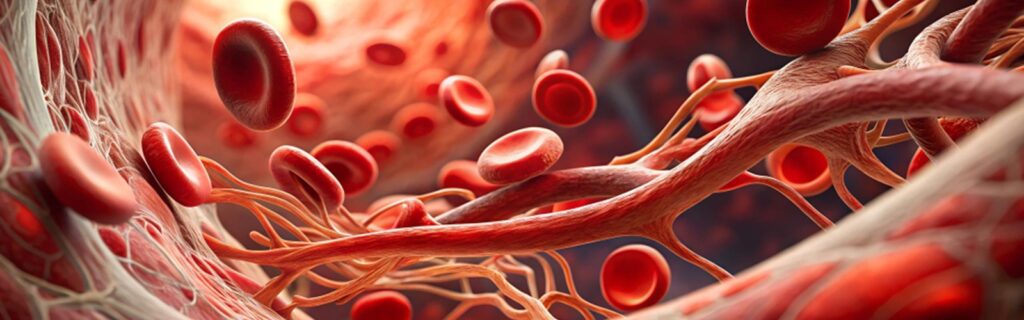
The large named arteries are the delivery routes, but the exchange itself happens at the capillary level. These microscopic vessels are where oxygen crosses from blood into brain tissue, where glucose is delivered to neurons, and where carbon dioxide and metabolic waste are collected for removal. Every neuron in the brain is within a fraction of a millimetre of a capillary. The density of this network reflects exactly how much the brain depends on continuous, uninterrupted supply.
Draining the Brain — The Venous System
After oxygen is extracted and metabolic waste is collected, blood must leave the brain efficiently. This is the job of the cerebral veins, which empty into large venous channels embedded in the dura — the tough membrane surrounding the brain — called dural venous sinuses.
The major sinuses — the superior sagittal sinus running along the top of the skull, the transverse and sigmoid sinuses along the back and sides — ultimately drain into the internal jugular veins and return blood to the heart.
This system is more clinically relevant than it’s sometimes given credit for. When venous drainage is obstructed — as in cerebral venous sinus thrombosis — the consequences can be serious and are frequently misdiagnosed because the presentation doesn’t look like a typical stroke.
The Blood-Brain Barrier
Brain circulation has one more feature that sets it apart from every other vascular bed in the body.
The blood-brain barrier is a structural property of the brain’s capillary walls — formed by specialised endothelial cells bound together so tightly that most substances cannot pass freely between blood and brain tissue. Oxygen, glucose, and a small number of essential molecules cross readily. Most toxins, many drugs, and a large number of pathogens cannot.
This protection is what makes the brain’s chemical environment so stable. It’s also what makes treating brain infections and certain tumours so difficult — getting medication across the blood-brain barrier is one of the central challenges in neurological pharmacology.
Cerebral Autoregulation — The Brain Manages Its Own Flow
The brain doesn’t just receive blood passively. It actively regulates its own circulation.
When neuronal activity increases in a particular region — during complex thinking, voluntary movement, or sensory processing — blood flow to that region increases within seconds. When blood pressure fluctuates, the cerebral vessels adjust their diameter to keep flow stable across a wide range of systemic pressures.
This process, called cerebral autoregulation, is one reason the brain tolerates normal daily variation in blood pressure without difficulty. It’s also one reason why catastrophic loss of autoregulation — in severe traumatic brain injury or large strokes — causes such rapid, difficult-to-manage deterioration.
When Circulation Fails
The consequences of vascular failure depend entirely on where in this system the problem occurs and how completely blood flow is interrupted.
A blocked middle cerebral artery causes stroke. A ruptured aneurysm floods the space around the brain with blood under arterial pressure. Bleeding into brain tissue compresses surrounding structures and raises intracranial pressure. A clot in the venous sinuses blocks drainage and causes the brain to swell from within.
These are not variations on the same theme. They are different emergencies, with different mechanisms, different imaging findings, and different treatment priorities. What they share is that brain tissue, once deprived of its blood supply for long enough, does not recover. Speed of recognition and speed of treatment determine outcomes in a way that is true of very few other conditions in medicine.
Why This Matters Clinically
Sudden weakness. A severe headache that feels different from any previous headache. Vision loss. Loss of balance. Confusion that comes out of nowhere.
These symptoms correlate with specific vascular territories. A neurologist hearing that a patient has sudden right arm weakness and difficulty finding words knows exactly which artery is likely involved before any scan has been performed. The anatomy is the roadmap.
That understanding is what makes rapid brain blood flow and stroke risk assessment possible — and what makes the first minutes after symptom onset so critical. The brain’s blood supply is not background physiology. It is the reason neurological emergencies are emergencies.
If you experience sudden neurological symptoms, immediate medical evaluation is not optional.
For expert diagnosis and advanced cerebrovascular care, consult Dr. Rajesh Reddy Sannareddy, Senior Consultant in Brain, Spine & Endovascular Neurosurgery.