
Introduction & Recovery at a Glance
For most patients, the weeks after brain tumor surgery are a time of uncertainty. Surgery is done — the tumor has been removed, or at least significantly reduced — but what comes next? How much pain is normal? When will the headaches stop? Is it normal to feel this tired? When can I drive again? When do I go back to work? Can I look after my family? These are the questions that fill the quiet hours after discharge, and they deserve clear, honest, practical answers.

This guide provides a week-by-week account of what recovery after brain tumor surgery typically looks like — from the first hours in the ICU to the return to normal life months later. It covers what is normal at each stage, what warning signs to watch for, what medications you will be taking and why, and what rehabilitation looks like for patients who need it.
Because recovery varies significantly depending on the type of tumor, the surgical approach, and the patient's individual health, this guide also provides a tumor-type-specific overview and addresses the specific needs of patients who will be going on to radiation and chemotherapy after surgery. Dr. Rajesh Reddy Sannareddy and his team support patients through every stage of this journey — from the first post-operative check to long-term surveillance imaging.
Recovery at a Glance: Phases and Milestones
| Phase | Timeframe | Key Focus | Milestone |
|---|---|---|---|
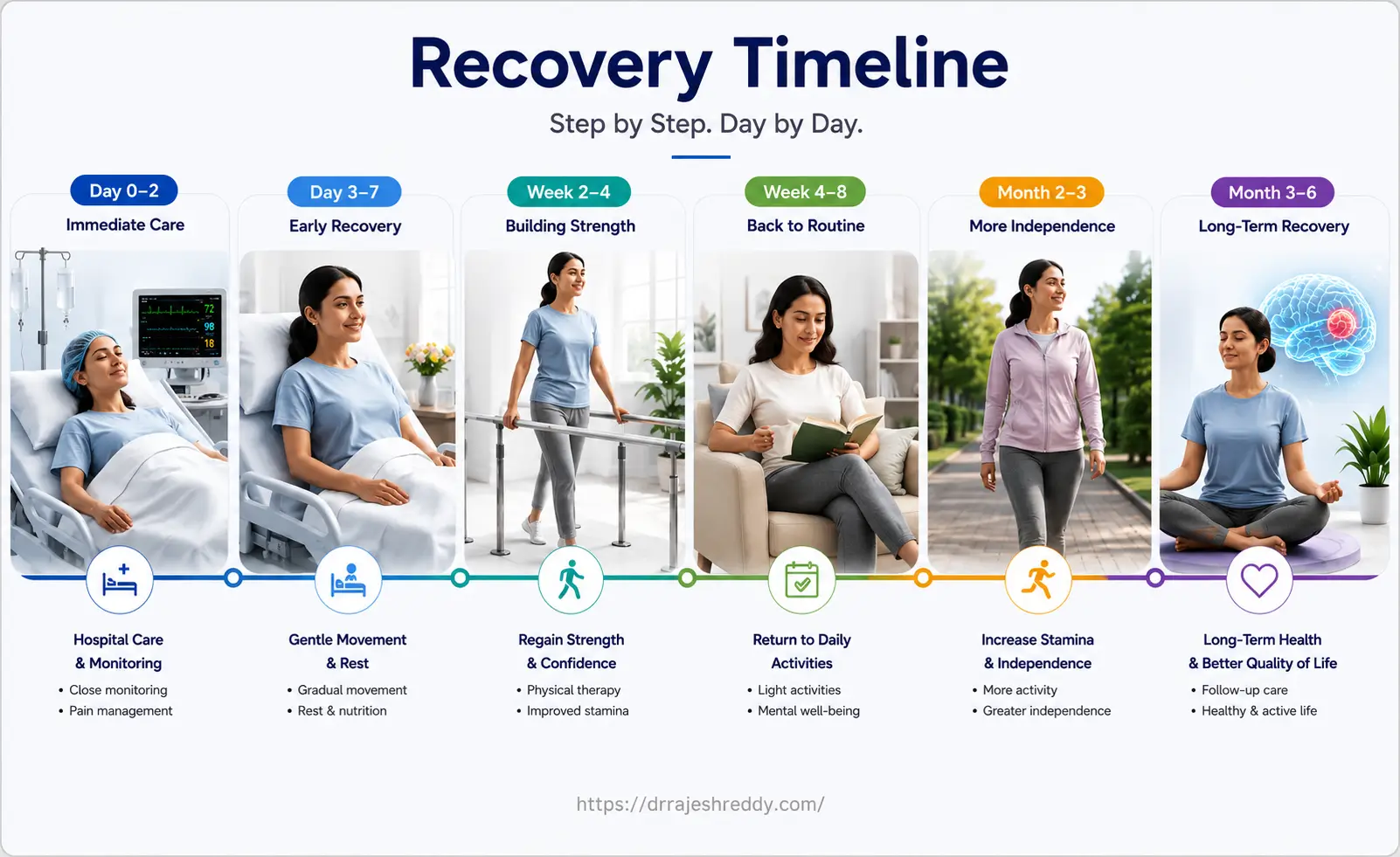
| ICU / HDU | Day 0–2 | Neurological monitoring, pain control, managing swelling | Wakes from anaesthesia; neurology stable; oral intake begins |
| Ward | Day 3–7 | Mobilisation, wound care, medication stabilisation | Walking independently; eating normally; ready for discharge |
| Early home recovery | Week 2–4 | Rest, fatigue management, wound healing | Sutures removed; headaches subsiding; light activity tolerated |
| Consolidation | Week 4–8 | Progressive activity, cognitive reintegration | Return to driving (seizure-risk assessed); desk work possible |
| Adjuvant treatment | Month 2–3 (malignant) | Radiation + chemotherapy (if applicable) | Oncology treatment underway; fatigue managed |
| Functional recovery | Month 3–6 | Rehabilitation, cognitive recovery, surveillance MRI | Return to normal activities; long-term plan established |
| Long-term surveillance | Annually | MRI monitoring; hormonal / neurological review | Stable disease; quality of life optimised |
Recovery Timelines by Tumor Type
| Tumor Type | Hospital Stay | Return to Normal Activity | Adjuvant Treatment? |
|---|---|---|---|
| Benign meningioma | 3–5 days | 6–10 weeks | No — surveillance MRI only |
| Pituitary adenoma (endoscopic) | 3–5 days | 1–2 weeks | Only if incomplete resection or Grade II/III |
| Low-grade glioma | 3–5 days | 8–12 weeks | Radiation ± chemotherapy in high-risk cases |
| High-grade glioma / GBM | 5–7 days | 4–6 weeks post-surgery (then adjuvant therapy begins) | Yes — radiation + temozolomide (Stupp protocol) |
| Metastatic brain tumor (single, resected) | 4–6 days | 4–8 weeks | SRS or WBRT + systemic therapy for primary cancer |
| Vestibular schwannoma | 4–6 days | 8–12 weeks (balance rehab needed) | No — surveillance MRI; radiosurgery if residual |
| Awake craniotomy (any tumor) | 3–5 days | 6–10 weeks (speech/motor rehab if needed) | Depends on tumor type |
Week-by-Week Recovery Guide
Day 0–2: Surgery Day and ICU / HDU
Immediately after surgery, you will wake in the recovery room. You will be transferred to the Neurosurgical ICU or HDU for close monitoring. Neurological observations (level of consciousness, pupil responses, limb movement, speech) are performed every 1–2 hours.
- Headache: Dull pressure ache around operative site, managed with IV and oral analgesics.
- Nausea: Common in the first 12–24 hours; routinely treated with anti-emetics.
- Fatigue: Exhaustion is normal as the brain uses significant energy for early healing.
- Facial Swelling: Peaks at 48–72 hours and resolves over 1–2 weeks.
- Steroids (Dexamethasone): Administered to control brain swelling.
SEEK IMMEDIATE ATTENTION IF YOU DEVELOP:
Sudden severe headache worse than before surgery — new or rapidly worsening weakness/speech loss — seizure — unequal pupils — sudden loss of consciousness.
Day 3–7: Ward Recovery and Discharge Preparation
By day 3, patients transfer to the neurosurgical ward. IV lines and urinary catheters are removed, and mobility begins with physiotherapy support.
- Post-operative MRI: Performed at 24–72 hours to confirm resection extent and establish a baseline.
- Wound Care: Sutures/staples are typically removed at 10–14 days.
- Physiotherapy & Speech Therapy: In-hospital assessment and mobility exercises commence.
- Discharge Criteria: Neurologically stable, walking independently or with minimal aid, eating/drinking normally.
Week 2–4: Early Home Recovery
The first two weeks at home prioritize rest. Fatigue is biology, not laziness — the brain requires quiet energy to repair itself.
- Fatigue: Peaks in week 2–3; short daily rest periods are normal and helpful.
- Headaches: Typically progressively improving to dull, intermittent discomfort managed with paracetamol.
- Scalp Numbness & Hair Loss: Numbness around the incision cut nerves regenerates over months. Hair thinning near the incision is temporary.
- Activity Restrictions: No driving for 4–6+ weeks (subject to medical clearance & seizure-risk assessment); no heavy lifting or strenuous exercise; no swimming until wound is fully healed.
Wound Care at Home
- Keep the wound clean and dry for the first 2 weeks.
- Gentle hair washing permitted after suture/staple removal (day 10–14).
- Avoid direct sun on the scar for at least 3 months — use a hat or sunscreen once healed.
- Do not apply creams, oils, or traditional remedies to the wound without medical advice.
Week 4–8: Progressive Recovery
By week 4, energy improves and cognitive 'brain fog' starts to clear. Focus shifts from rest to gradual reintegration into daily life.
Cognitive Recovery
Brain surgery can temporarily impair concentration, word-finding, short-term memory, and processing speed as the brain heals. Practical strategies during this phase:
- Use lists and reminders for tasks previously done from memory.
- Take regular breaks during cognitively demanding activities (reading, screens, conversation).
- Avoid multitasking; focus on one activity at a time.
- Accept help from family members; cognitive fatigue is real and should not be pushed through.
Return to Work & 6-Week Review
- Return to Work: Desk jobs from week 4–6 (starting part-time); manual or physical roles from 3–6 months.
- 6-Week Follow-Up Appointment: 6-week MRI review, neurological exam, steroid/AED tapering plan, and pathology/oncology treatment planning.
Month 2–3: Adjuvant Treatment (Malignant Tumors)
For patients with high-grade gliomas (GBM) or brain metastases, adjuvant radiation and chemotherapy begin around week 4–6.
- Stupp Protocol (GBM): 6 weeks of daily radiotherapy (60 Gy) + daily oral temozolomide, followed by 6 monthly cycles of adjuvant temozolomide.
- Fatigue Management: Prioritize 8–9 hours of sleep, light 15-minute daily walks, and adequate nutrition with clinical dietitian support.
Month 3–6: Functional Recovery and Rehabilitation
For patients requiring ongoing functional recovery, targeted rehabilitation services help optimize long-term independence:
- Physiotherapy: Progressive exercises for motor strength, gait, and balance (deficits continue to improve up to 12 months).
- Speech and Language Therapy (SLT): Structured home & clinic exercises for word-finding and articulation.
- Occupational Therapy: Workplace adaptation and daily task independence.
- Neuropsychological Rehabilitation: Structured cognitive strategies guided by 3-month neuropsychological assessment.
- Psychological Support: Routine counselling for anxiety, depression, and coping strategies for patients and caregivers.
Medications After Brain Tumor Surgery: What You Are Taking and Why

| Medication | Purpose | Typical Duration |
|---|---|---|
| Dexamethasone (steroid) | Reduces post-operative brain swelling | Tapered over 1–2 weeks; longer if significant oedema |
| Anti-epileptic drug (AED) | Prevents post-operative seizures | Minimum 3 months; often 6–12 months depending on tumor type |
| Proton pump inhibitor (e.g., pantoprazole) | Protects stomach lining from steroid-related irritation | Duration of steroid course |
| Analgesics (paracetamol) | Post-operative headache and wound pain | First 1–2 weeks; weaned as pain improves |
| Antinausea medication | Controls post-operative nausea from anaesthesia | First few days |
| DVT prophylaxis (heparin) | Prevents blood clot in legs / lungs | Until mobile; usually 1–4 weeks |
| Hormone replacement | For pituitary patients with post-op hypopituitarism | Long-term — guided by endocrinology |
Safety Warning:
Never stop anti-epileptic medication suddenly without medical advice — sudden discontinuation can trigger seizures even in patients who have never had one before. Always contact Dr. Rajesh Reddy's clinic before making any changes.
Warning Signs: When to Seek Urgent Help
SEEK IMMEDIATE MEDICAL ATTENTION IF YOU EXPERIENCE:
- A new or first seizure at any point after discharge
- Rapidly worsening headache different from your usual post-op headache
- New weakness, speech loss, or vision change
- Fever above 38.5°C with headache and stiff neck
- Wound that is red, hot, swollen, or discharging pus
- Clear fluid dripping from the nose (possible CSF leak after pituitary surgery)
- Sudden confusion or unresponsiveness
Symptoms That Are Normal and Do Not Require Emergency Care
- Mild to moderate headache that is improving over time — manageable with paracetamol
- Fatigue, even if profound — this is a normal part of brain healing
- Scalp numbness, tingling, or itching around the wound — nerve regeneration
- Mild mood changes or emotional sensitivity
- Some degree of cognitive fog or word-finding difficulty in the first 6 weeks
- Hair thinning around the wound site — almost always temporary
A Note for Caregivers and Family Members
Brain tumor surgery does not happen to a patient in isolation — it happens to a family. Caregivers carry an enormous burden during the recovery period: providing physical care, managing medications, attending appointments, and supporting the patient emotionally while managing their own anxiety and grief.
Practical Guidance for Caregivers
- Keep a medication record: Note the name, dose, and timing of every medication, and tick it off when given. Errors in medication are a significant source of post-discharge problems.
- Observe and report: You will often notice neurological changes before the patient does. If the patient seems more confused, slower, or different from their baseline, contact the clinic.
- Encourage but do not push: Fatigue is real, and patients cannot think their way through it. Balance encouragement to move with acceptance that rest is part of healing.
- Monitor mood: Depression and anxiety after brain tumor surgery are common and treatable. If the patient withdraws or expresses hopelessness, discuss this with Dr. Rajesh Reddy.
- Look after yourself: Caregiver burnout is real. Accept help from extended family, friends, and community.